
Why Google’s New ‘Ask Maps’ Feature Means Your Business Needs a Virtual Tour Right Now: Why a Virtual Tour is Your Secret Weapon
The world of local search is about to experience its biggest shake-up in a decade. Google has officially begun rolling out ‘Ask Maps’—a major AI-driven upgrade powered by its Gemini models. Currently making waves in the US and India, this revolutionary conversational search tool is headed directly for the UK.
For local business owners, the rules of getting found online are changing overnight. The days of simply typing a keyword like “coffee shop near me” and scrolling through a flat list of results are fading. Instead, users can now have full, natural-language conversations with Google Maps.
At I See You Online, we are tracking this rollout closely. There is one distinct tool that will act as your ultimate secret weapon when Ask Maps lands in the UK: a high-quality Google Virtual Tour.
What is Google ‘Ask Maps’ and How Does it Work?
Instead of relying on rigid filters, Ask Maps allows users to ask highly specific, multi-layered questions, such as:
“Where can I find a cozy restaurant nearby with a private booth for a business meeting, and what’s the parking like?”
or
“Show me a local boutique hotel that has a vintage aesthetic and easy physical accessibility for wheelchair users.”
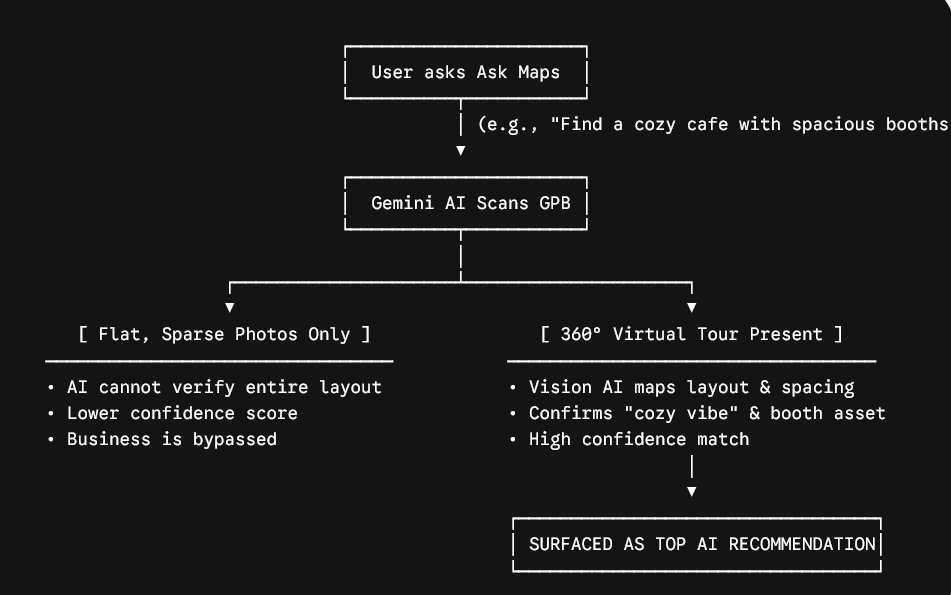
To answer these complex queries, Google’s AI doesn’t just look at your business name or category. It aggressively crawls everything available—your website data, customer reviews, social signals, and most importantly, your visual data. It analyzes the actual environment of your business to determine if you truly match the “vibe” or functional requirements the user is asking for.
The Shift: Google’s Vision AI is “Watching” Your Business
Google uses highly advanced Vision AI to scan and understand imagery. When a user asks Ask Maps for a location with a specific atmosphere (“industrial chic,” “rustic,” “bright and airy,” “family-friendly layout”), the AI scans your uploaded photos and virtual tours to verify that your space matches that description.
This is where a standard, flat photo gallery falls short, and where a Google Virtual Tour becomes an integral part of your SEO strategy.
1. It Proves the “Vibe” and Layout to the AI
A 360-degree virtual tour provides a continuous, unbroken data map of your physical location. Google’s AI can navigate your virtual tour just like a human would, instantly cataloging your interior design, table spacing, seating types, and overall aesthetic. When Ask Maps searches for a specific atmosphere, businesses with comprehensive virtual tours will be heavily favored because the AI can visually verify the claim.
2. It Answers Specific Accessibility and Structural Questions
If an Ask Maps user asks, “Which local pubs have spacious seating layouts and no steps at the entrance?”, the AI looks for physical proof. A virtual tour provides definitive spatial data. It allows Google to confidently recommend your business because the structural layout is mapped out transparently in 3D data.
3. Complete Profiles Win the AI Recommendation Game
Early data from the SEO community shows that Google’s new AI search layer prioritises attribute completeness over sheer review volume. A business with fewer reviews but a highly detailed, media-rich Google Business Profile—including a premium virtual tour—frequently outperforms older, static profiles. The AI wants to recommend spaces it “understands” best.
Get Ahead of the Curve with I See You Online
When Ask Maps goes live across the UK, local search will no longer be about who has the best keywords—it will be about who provides the best data to Google’s AI.
At I See You Online, we specialise in helping businesses stand out exactly where their customers are looking. We don’t just build high-performance websites and optimise your hosting; we create immersive, professional Google Virtual Tours that feed Google’s AI engine exactly what it needs to see.
Don’t wait until your competitors adapt to the AI revolution. Let’s get your physical space mapped, optimised, and ready to dominate the future of Google Maps.